

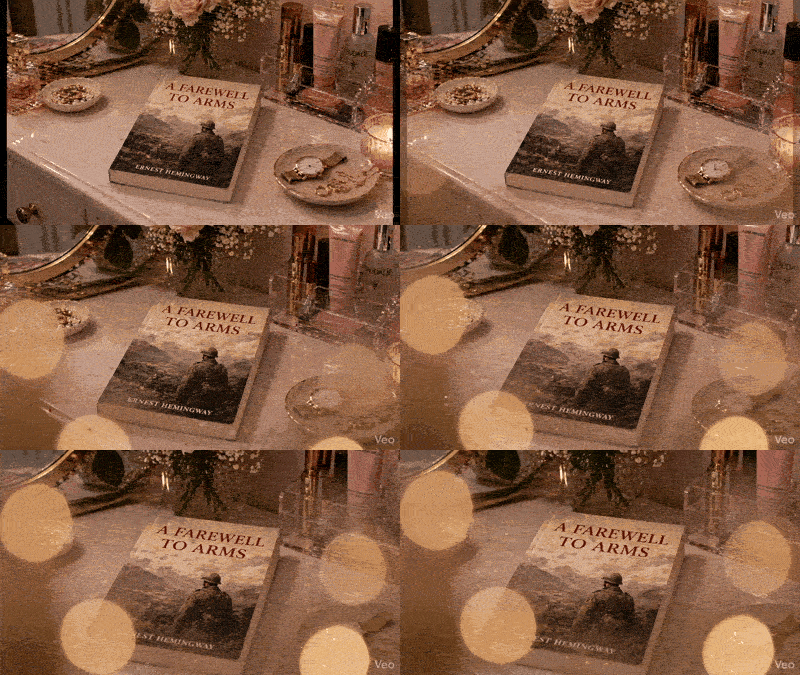
2026/05/06 A Farewell to Arms
In the present wartime, it is natural to be anxious about its impact on our lives. Revisiting books on war may provide some insight into how wars have affected people throughout history. Today’s book is A Farewell to Arms, written by Ernest Hemingway and first published in English in 1929.
Set against the backdrop of the First World War, A Farewell to Arms traces the quiet disintegration of ideals through the experiences of individuals caught between duty, desire, and disillusionment.
At the center is Lieutenant Frederic Henry, an American serving as an ambulance driver in the Italian army. Initially, Frederic works with a kind of detached compliance. He drinks, engages in casual relationships, and follows orders without strong ideological commitment. War, for him, is something to be endured rather than understood. This emotional distance begins to shift after he is wounded in a mortar attack that interrupts not just his physical movement but his internal detachment.
During his recovery, Frederic develops a relationship with Catherine Barkley, an English nurse, who has lost her fiancé to the war. What begins as a somewhat performative romance gradually becomes more sincere, though it remains marked by an underlying fragility. Catherine’s devotion is intense, at times bordering on self-effacing, while Frederic’s growing attachment signals a movement away from the indifference that once defined him.
Around them, the war continues to assert its presence. Rinaldi, the surgeon, embodies a different response: one of outward vitality and denial, masking exhaustion with humor and excess. Others, like the priest, offer a quieter moral perspective, suggesting alternative ways of understanding suffering and purpose.
A turning point comes during the Italian retreat following a disastrous military setback. The retreat is marked not by strategy but by confusion, fear, and breakdown. Order dissolves, and with it, any lingering sense of structure or justification. Frederic’s eventual desertion is less an act of rebellion than a recognition of futility. War, in this moment, ceases to hold even the minimal coherence it once did.
What follows is a shift in setting but not in tension. Frederic reunites with Catherine, and the two escape to Switzerland, seeking a life removed from the conflict. For a time, their existence takes on a quieter, almost suspended quality: days shaped by routine, anticipation, and the expectation of their child. Yet this apparent refuge does not resolve the underlying instability. The war may be geographically distant, but its effects linger in the form of uncertainty and emotional fragility.
The novel’s conclusion resists consolation. Catherine’s death during childbirth, along with the loss of their baby, collapses the final space of meaning Frederic has constructed. What remains is not resolution, but absence. His journey from detachment to attachment, and ultimately to loss mirrors the broader arc of the novel itself.
Thus, A Farewell to Arms shows how ideals of honor, love, and purpose are not violently overturned but gradually eroded. In their place remains a quieter, more unsettling recognition: that meaning, if it exists at all, is fragile and often contingent.
The article is researched and composed by Saily Bhagwat.