

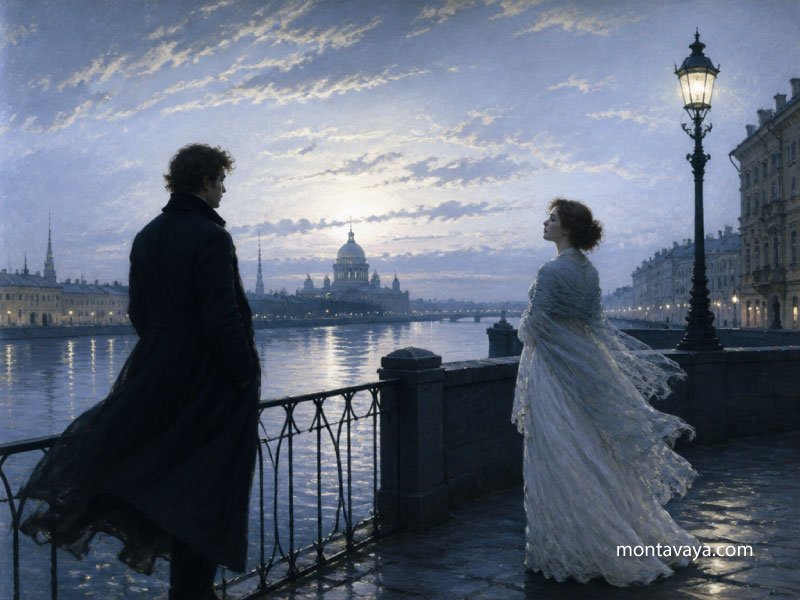
2026/06/02 White Nights: A Story So Quiet, Cinema Had to Speak Louder
Some stories whisper so softly that adapting them for the screen feels like turning a diary into a stage play. White Nights, written by Fyodor Dostoevsky and published in 1848, is built almost entirely on inner emotion. It follows a lonely dreamer and a brief connection that changes him, not through action, but through feeling.
One of the most memorable lines from the novella captures this tone perfectly: “My God, a whole moment of happiness! Is that too little for the whole of a man’s life?” This line sums up the story’s essence. It is not about lasting love, but about how even a fleeting emotional moment can feel complete. For filmmakers, this creates a challenge. How do you show something that is meant to be felt more than seen?
One of the earliest notable adaptations is Le Notti Bianche, directed by Luchino Visconti. Instead of recreating the real streets of St. Petersburg, Visconti chose to build an entirely artificial, dreamlike set. This was a deliberate production choice. Since the story itself feels detached from reality, the setting was designed to reflect that emotional distance. It worked well for many viewers, though some felt the stylisation made the story feel less personal.
The novella also found its way into Indian cinema through Saawariya, directed by Sanjay Leela Bhansali. Released in 2007, the film marked the debut of Ranbir Kapoor and Sonam Kapoor, which immediately brought attention to the project. However, this also created pressure. Launching two newcomers in a visually grand film based on a subtle, emotional story was seen as a risky move.
There was also noticeable industry chatter around its release, as Saawariya clashed at the box office with another major film, Om Shanti Om. This overshadowed its reception and led to mixed responses. While some appreciated its visual style, others felt the emotional simplicity of White Nights was lost under heavy set design and dramatic presentation. In simpler terms, the film expanded the scale, but in doing so, it moved slightly away from the quiet intimacy of the original.
Since White Nights is in the public domain, filmmakers are free to adapt it without purchasing exclusive rights. This explains why the story has been retold across different cultures, each version shaped by its own cinematic language.
Across these adaptations, one pattern stands out. The central idea of a brief, meaningful connection is always preserved, but the way it is expressed changes. Films often add more visual drama or restructure the narrative because a purely internal story is difficult to sustain on screen.
In the end, White Nights remains less of a fixed story and more of a feeling that keeps being reinterpreted. And it leaves us with a quiet question: if a single moment of happiness can feel complete in a book, does stretching it into a film make it richer, or does it risk losing what made it special?
Researched and Written by Shrirang Khare