

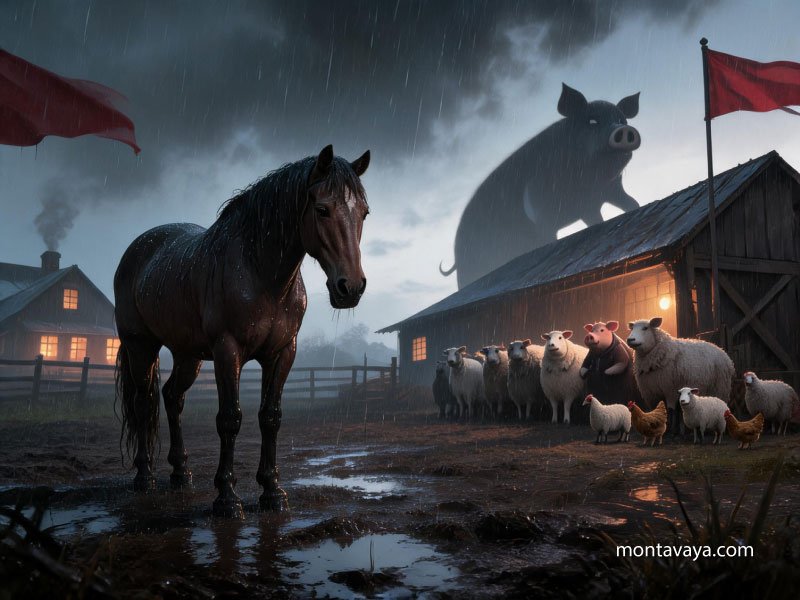
2026/06/02 Animal Farm: The Book Students Think They Understand Until the Essays Begin
Few books suffer from their own popularity quite like Animal Farm. Written by George Orwell and published in 1945, the novella is often introduced as a simple political allegory about a group of farm animals overthrowing their human owner. That description is not wrong, but it is also the reason many students underestimate it. What appears to be a straightforward story quickly becomes one of the most dissected texts in literature classrooms.
The book entered academic curricula for obvious historical reasons. Orwell wrote it during the final years of World War II, drawing heavily on the events surrounding the Russian Revolution and the rise of the Soviet Union. Today, however, it is taught far beyond history-focused modules. Students encounter it in English literature, political science, media studies, history, and even communication courses. The reason is simple: the book is not just about one political system. It is about how language, leadership, and power interact in any society.
This is precisely why professors continue assigning it. Many classroom discussions begin with the famous line, “All animals are equal, but some animals are more equal than others.” At first glance, students recognise it as hypocrisy. But university seminars often push further. How does language make obvious contradictions seem acceptable? Why do populations sometimes accept changes that work against their own interests? In simple terms, Orwell turns a farm into a case study of how power can reshape reality itself.
The book’s academic interpretation has shifted dramatically over the decades. Students in the 1950s and 1960s often studied it primarily as an anti-Soviet text. Modern classrooms tend to take a broader approach. Contemporary scholars examine propaganda, misinformation, political branding, and the manipulation of public memory. Characters like Squealer have become particularly important in media studies because of the way they control narratives. Some instructors even compare Squealer’s techniques to modern advertising campaigns and political messaging, showing how a text written nearly eighty years ago can still feel surprisingly current.
What makes Animal Farm especially useful in educational settings is its efficiency. At just over a hundred pages, it can be taught in a relatively short period while supporting discussions that would normally require much larger texts. This is one reason it appears so frequently in introductory literature and political theory courses. Students can read it quickly, but analysing it is another matter entirely.
It has also developed a reputation among students for being deceptively difficult. Many first-time readers assume every animal represents a single historical figure and stop there. Professors often spend entire lessons challenging that assumption, encouraging students to focus on larger themes rather than treating the novella as a simple decoding exercise.
Perhaps that is why Animal Farm remains firmly established on academic bookshelves. It offers a rare combination of accessibility and complexity, rewarding both first-time readers and advanced scholars.
And nearly eight decades after its publication, the same question continues to surface in classrooms around the world: if people can recognise manipulation when reading about it on a farm, why is it so much harder to recognise when it happens in real life?
Researched and Written by Shrirang Khare