

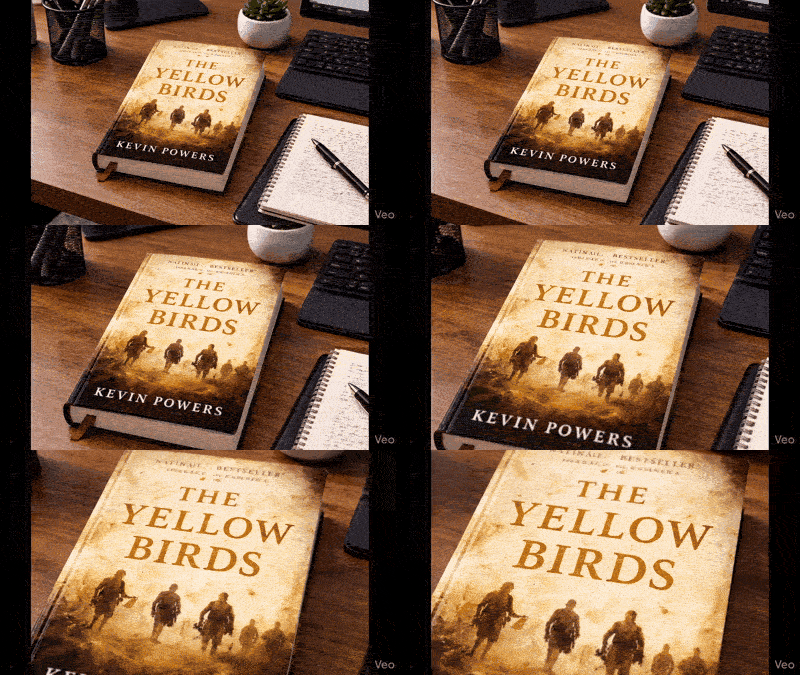
2026/05/06 The Yellow Birds
In the present wartime, it is natural to be anxious about its impact on our lives. Revisiting books on war may provide some insight into how wars have affected people throughout history. Today’s book is The Yellow Birds, written by Kevin Powers and published in 2012.
Set during the Iraq War, The Yellow Birds traces the psychological and moral unravelling of soldiers caught between duty, survival, and the quiet aftermath of violence.
At the center is Private John Bartle, a young American soldier who enters the war with a vague sense of obligation rather than conviction. Early in his deployment, he makes a promise to the mother of Daniel Murphy, an inexperienced eighteen-year-old soldier, that he will bring her son home safely. This promise becomes the moral axis of the novel, quietly shaping Bartle’s actions and, eventually, his unraveling.
Murphy himself is less a fully formed individual and more a fragile presence. He is someone onto whom others project responsibility and fear. His vulnerability stands in stark contrast to the hardened environment around him. As the war intensifies, Murphy struggles to adapt, and his inability to reconcile the chaos around him becomes increasingly apparent. His fate, when it comes, is not heroic or dramatic, but deeply unsettling in its ambiguity and violence.
Hovering above both is Sergeant Sterling, their superior officer, who embodies a more experienced, if not entirely stable, response to war. He is authoritative and pragmatic, but also shaped by his own coping mechanisms that blur the line between discipline and moral compromise. Through Sterling, the novel suggests that survival in such conditions often demands a recalibration of values, one that may not hold up once the war ends.
The narrative itself moves non-linearly, shifting between Bartle’s time in Iraq and his return home. This fractured structure mirrors his mental state. Time does not progress cleanly; instead, it loops, stalls, and collapses. Memories intrude unpredictably, and the boundary between past and present becomes porous. In Iraq, the landscape is both physical and psychological. Heat, dust, and constant tension form a backdrop where meaning itself feels unstable. Back home, Bartle finds no clear separation from what he has experienced. The war persists, not as an event, but as a condition.
Central to the story is the idea of responsibility, not only in terms of military duty but also personal accountability. Bartle’s promise to Murphy’s mother becomes an unbearable weight after Murphy’s death, especially as the circumstances surrounding it are obscured by secrecy and guilt. The novel resists providing clean answers. Instead, it presents a moral fog where truth is fragmented, and the act of remembering becomes as painful as the original experience.
Murphy’s absence, more than his presence, shapes the latter half of the narrative. His death is not simply a loss but a rupture that destabilizes Bartle’s sense of self.
Across its characters, The Yellow Birds presents a consistent pattern: war does not just threaten life; it erodes coherence of identity, memory, and morality.
This article is researched and composed by Saily Bhagwat.