

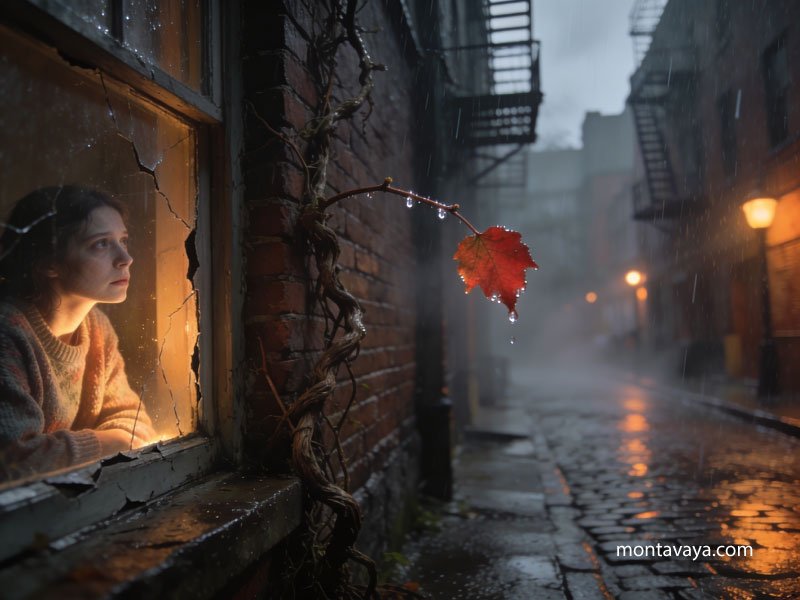
2026/06/02 The Last Leaf: A Story So Beautiful, It Found Life in Unexpected Places
It is not every day that a story built around a single falling leaf travels across time and quietly reshapes itself in different forms. The Last Leaf, written by O. Henry and published in 1907, is one such work where very little happens outwardly, yet everything changes within.
At the heart of the story lies a simple but powerful line: “When the last leaf falls, I must go too.” This belief drives the emotional core of the narrative. For readers, it shows how fragile hope can be. For filmmakers, it creates a challenge: how do you build an entire visual story around such a quiet, internal idea?
Unlike many popular works, The Last Leaf was not turned into a large standalone film. Instead, it found its way into cinema through reinterpretation. One of the most notable examples is Lootera, directed by Vikramaditya Motwane.
Released in 2013, Lootera is not a direct adaptation of the full story but draws heavily from its final act. The film builds an entirely new narrative in its first half, establishing characters and relationships, before gradually moving into a portion inspired by The Last Leaf. This is a significant creative choice. Instead of stretching the short story, the film embeds it within a larger plot. In simple terms, it uses the original story as an emotional anchor rather than a complete blueprint.
There was also some quiet industry discussion around how openly the film acknowledged its inspiration. While it was known that The Last Leaf influenced the second half, the adaptation was not marketed as a direct retelling. This is not unusual, as filmmakers sometimes prefer to position such works as “inspired by” rather than strict adaptations, giving them more creative freedom.
In terms of execution, the Lootera adaptation stays true to the emotional essence of the original. The idea of hope tied to something as fragile as a falling leaf is preserved, though the context and characters are different. At the same time, the film expands the story visually and emotionally, adding layers of romance, loss, and redemption that are not present in the original text.
From a production perspective, this approach solves a key problem. Since The Last Leaf is a very short story, adapting it directly into a full-length film would require significant additions. By building a larger narrative around it, Lootera avoids this issue while still retaining the story’s emotional impact.
Since the original work is in the public domain, filmmakers are free to reinterpret it without acquiring rights, which makes such creative adaptations possible.
In the end, The Last Leaf proves that even the smallest stories can travel far when placed in the right hands. And it leaves us with an interesting thought: when a story is reimagined rather than retold, does it lose its identity, or does it gain a new one?
Researched and Written by Shrirang Khare