

2026/09/02 How to Get an ISBN in India: The Complete Guide!
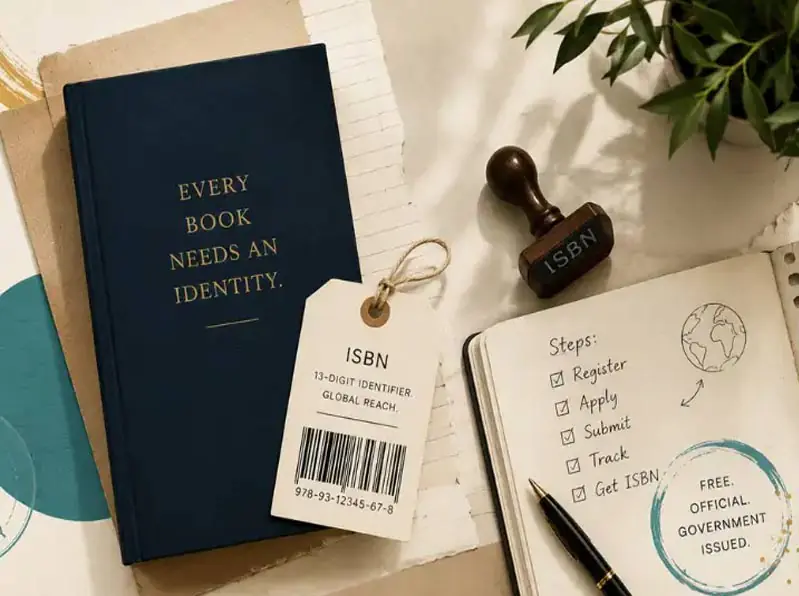
Every book needs an identity before it can reach a shelf, and in the publishing world, that identity is a thirteen-digit number. It’s a small detail that trips up a surprising number of first-time authors — partly because ISBNs cost money in many countries, and partly because a whole industry of paid “publishing consultants” has grown up around a process that’s actually free and fairly simple once you know the steps.
What an ISBN Actually Does
An ISBN, or International Standard Book Number, is what lets a bookstore, library, or online retailer identify your book unambiguously among millions of others. It’s tied to a specific edition and format — a paperback, a hardcover, and an ebook of the same title each need their own number — and without one, most major retailers and libraries simply won’t list your book. If you’re planning to sell through Amazon India, Flipkart, or any physical bookstore, this is a step you can’t really skip.
Who Issues It in India, and Why Does It Not Cost Anything
This is where India differs from a lot of the world. In the US, authors typically buy ISBNs from a private agency, Bowker, at a real cost per number. In India, the entire system runs through a single government body: the Raja Rammohun Roy National Agency for ISBN, functioning under the Ministry of Education. It’s been the country’s sole ISBN authority since 1985, and it issues numbers completely free of charge to any Indian author, publisher, or institution. If someone offers to sell you an ISBN or bundles a “registration fee” into a publishing package, that’s a service fee for doing the paperwork on your behalf — not a cost the government itself charges.
What You’ll Need Before You Start
The process runs entirely online, so gather a few things before you begin: a valid photo ID (Aadhaar or PAN card work fine), address proof, and clarity on which applicant category you fall into. The portal distinguishes between individual authors, self-publishers, institutional publishers, and commercial publishers, and the category you register under affects the rest of the application. Have your book’s basic details ready too — title, format, and ideally a copy of the title and verso pages, since the agency sometimes asks for these during verification.
The Application, Step by Step
Start at the official portal, isbn.gov.in — it’s the only legitimate place to apply, so it’s worth bookmarking to avoid look-alike sites. From there:
- Register as a new applicant, providing your name, email, and phone number, and selecting your applicant type.
- Verify your email, then log in and complete the full registration form with your personal or organisational details, uploading your ID and address proof.
- Wait for registration approval. This is the first of three checkpoints the application passes through — registration approval, category approval, and finally ISBN allotment.
- Apply for your ISBN once your profile is active, choosing between a single title (print or digital) or a bulk request if you’re registering multiple books.
- Fill in your book’s metadata carefully — title, author name, format, and edition — since this is what libraries and retailers will eventually use to list your book.
- Submit and track your application from your dashboard until the ISBN is issued, at which point you can download your certificate.
How Long It Realistically Takes
Most straightforward applications are approved within two to four weeks, though this can stretch longer if the agency asks for manual verification or if you’re applying for a large block of numbers as a publisher. It’s worth building this timeline into your publishing schedule with some buffer, rather than assuming it’ll be instant.
One Thing the ISBN Doesn’t Include
The agency issues the thirteen-digit number itself, but not the scannable EAN-13 barcode that goes on your book’s back cover — that has to be generated separately, usually through your self-publishing platform or a simple online barcode generator. And remember that every distinct version of your book needs its own ISBN: if you’re releasing a paperback and an ebook, that’s two separate numbers, not one shared across formats.
A Word on Paid Middlemen
Because the process is genuinely free, it’s worth being cautious of any service that positions ISBN registration as a premium or paid offering on its own. Many self-publishing companies bundle ISBN application into their packages as a convenience — handling the paperwork so you don’t have to — and that’s a reasonable thing to pay for if you’re short on time. But if anyone implies the ISBN itself has a government fee attached, that’s simply not accurate in India, and it’s worth applying directly if keeping costs down matters to you.