

2026/09/02 Self-Publishing vs. Traditional Publishing: Which Path Is Right for Your Book in India?
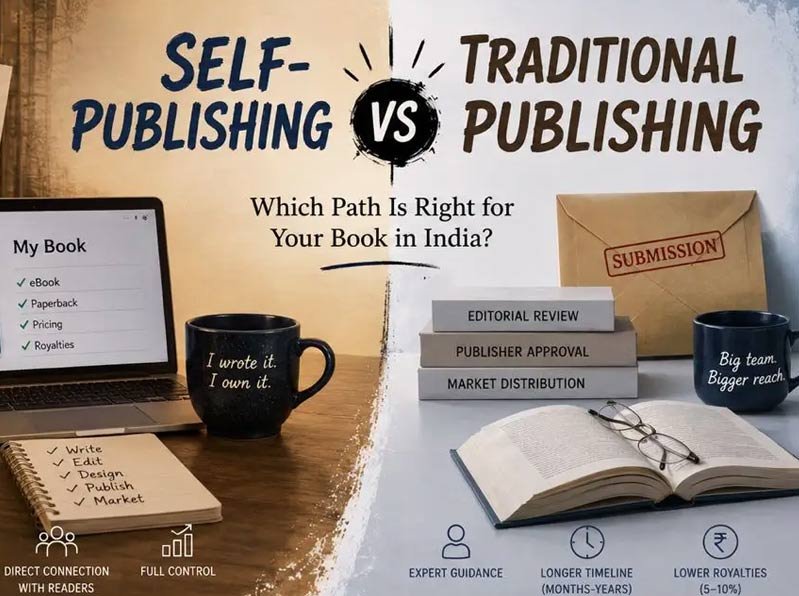
Every Indian author eventually reaches the same crossroads: send the manuscript out to publishers and wait, or publish it directly and start selling. Both roads end with a finished book, but the money, the timeline, the control, and the sheer effort involved look quite different depending on which one you take.
The Traditional Route
Traditional publishing means submitting your manuscript to a publishing house, usually through a literary agent, and letting them decide if it’s worth the investment. In India, that could mean a big English-language name like Penguin Random House India, HarperCollins, or Rupa Publications, or an equally established vernacular house — Rajkamal Prakashan and Prabhat Prakashan have been shaping Hindi literature for decades, alongside strong regional publishers working in Marathi, Tamil, Bengali, and Punjabi.
If a publisher says yes, they fund and run the whole process: editing, cover design, printing, distribution. In return, you give up a fair share of both control and revenue. Indian royalty rates usually land somewhere between 5% and 10% of the cover price for paperbacks, a little more for hardcovers, and around 20-25% of net sales for ebooks. Most publishers also offer an advance — commonly ₹25,000 to ₹1,50,000 for a debut author — but this isn’t a bonus; it’s a loan against future royalties, and until the book earns that amount back, no further payments come in. Many debut books never quite get there.
What you do get is real: an experienced editorial team, a professional cover, and bookstore shelf space that’s hard to access on your own. What you trade for it is time — often a year or more before the book reaches shelves — and a good deal of creative say.
The Self-Publishing Route
Self-publishing flips this arrangement on its head. Instead of a publisher absorbing the cost and risk, you do, and in return you keep most of what the book earns.
For most Indian authors, this means a platform like Amazon KDP, Notion Press, Pothi.com, or BlueRose Publishers. KDP pays royalties between roughly 35% and 70% depending on price and format, and Indian platforms follow a similar pattern, with self-published authors often keeping 70% to 100% of net profits — a sharp contrast to the 7-12% typical in traditional deals. Costs vary just as widely: a simple digital-only release can cost a few thousand rupees, while a full-service package with professional editing, design, and marketing can run into six figures.
The catch: nothing here is truly free — it just shifts the cost from the publisher’s ledger to yours, in rupees or in hours. You’re now the one hiring the editor, commissioning the cover, formatting the file, pricing it, and doing the legwork so someone actually finds your book.
What This Really Comes Down To
Strip away the details, and the choice sits on four things. Traditional publishing pays less per copy but costs nothing upfront and comes with a guaranteed advance; self-publishing pays more per copy but asks you to fund the process first. Traditional deals move slowly, often over a year; self-published books can go live within weeks. A publisher has the final word on your cover, title, and edits; self-publishing hands you full control, with no gatekeeper to catch mistakes first. And while a publisher brings existing ties to bookstores and reviewers, a self-published author can list on Amazon India and Flipkart within days — though real visibility beyond that still takes sustained work.
For authors writing in an Indian language, this calculation shifts slightly. Vernacular publishing is a strong, well-established industry of its own in India, so traditional publishing was never a purely English-language route to begin with. If self-publishing appeals to you instead, it’s worth confirming upfront that your chosen platform actually supports your language’s script properly, since not all of them handle Indian scripts and formatting equally well.
So, Which One Should You Choose?
There’s no single right answer here — only the trade-off you’re more willing to live with. Traditional publishing suits you if credibility and wide distribution matter more than speed, and you’re comfortable waiting. Self-publishing suits you if you’d rather move fast, keep control, and either learn the production side yourself or pay for it directly.
Plenty of authors also treat this as a sequence rather than a single choice — trying traditional publishing first, and turning to self-publishing if the manuscript doesn’t find a home. Increasingly, a strong self-published sales record can even become the pitch that gets a traditional publisher’s attention in the first place.
Neither path is a shortcut. One trades money and control for credibility and reach; the other trades security and structure for speed and ownership. The better question isn’t which sounds more impressive — it’s which trade-off actually fits how you want to work.