
2026/09/02 Professional Manuscript Editing Services: Why They Matter!
A self-published book doesn’t get a separate shelf. On Amazon or Flipkart, it sits in the same search results as a title that went through a traditional publisher’s full editorial team, and readers judge both by the same standard, whether that feels fair or not. That single fact is why professional editing matters more for independent authors than almost anyone tells them upfront.
Why Self-Editing Alone Usually Isn’t Enough
Every author edits their own work to some degree, and that pass matters — but it has a real limit. By the time you’ve read your manuscript for the fifth or sixth time, your brain has started filling in gaps and skimming past errors the same way it does with any text you’ve become too familiar with. This isn’t a failure of discipline; it’s just how attention works. A professional editor comes to the manuscript with no such familiarity, which is exactly what lets them catch the inconsistency you stopped seeing, the chapter that quietly loses momentum, or the plot thread that never gets resolved. Friends and family, however well-intentioned, run into a version of the same problem from a different angle — most people who care about you will soften their feedback rather than risk hurting your feelings, which means you often get reassurance instead of the honest read you actually need.
What Skipping It Actually Costs You
The consequences of publishing an unedited or under-edited manuscript rarely show up as a single dramatic failure — they show up quietly, in the reviews. A reader who hits repeated typos, a confusing timeline, or a plot hole doesn’t usually finish the book and recommend it; they mention the roughness in a review, and that review becomes the first thing the next potential reader sees. Because reviews also feed directly into how Amazon and Goodreads decide to surface your book to new readers, a handful of “needed more editing” comments can quietly suppress a book’s visibility long after launch. None of this is really about grammar for its own sake — it’s about whether a reader trusts you enough to keep going, and whether they trust you enough to pick up your next book.
Why AI Tools Don’t Close the Gap
It’s tempting to assume a grammar checker or AI writing tool covers most of what an editor does, and for surface-level spelling and punctuation, it genuinely helps. But structure, pacing, whether a chapter earns its place, whether a character’s motivation actually holds up — none of that is something a grammar tool evaluates, because it isn’t reading for meaning the way a trained editor is. A professional editor brings judgement: they can tell you a manuscript needs restructuring before it needs polishing, which is a distinction no automated tool is positioned to make. Treating AI tools as a genuine substitute for professional editing is usually how authors end up with a technically clean manuscript that still doesn’t work as a book.
What You’re Actually Paying For
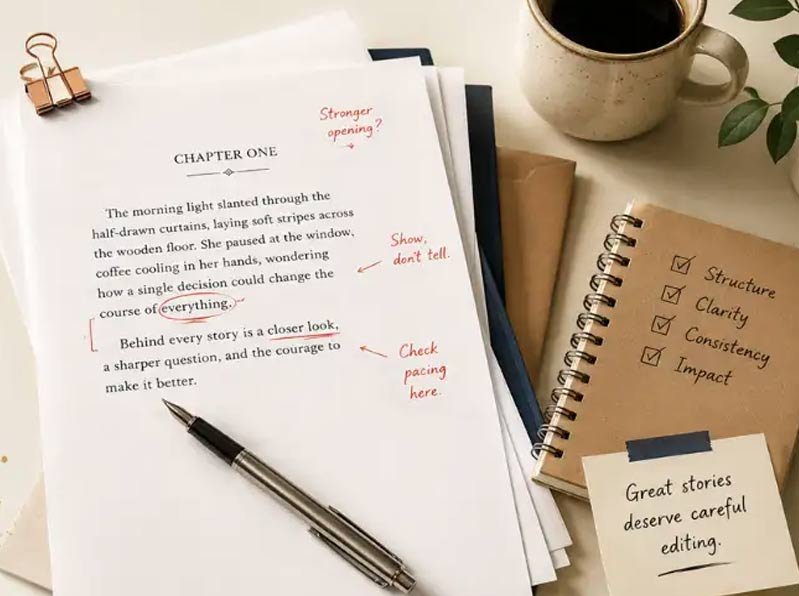
A good editor isn’t just correcting your sentences — they’re giving you the reader’s-eye view of your own book, which is something you structurally cannot get by reading your own work, no matter how many passes you do. They’ll tell you honestly where the middle sags, where a character disappears from the story, or where a chapter needs cutting entirely, and they’ll do it without the social hesitation a friend brings to the conversation. That honest distance is, in a real sense, the entire product — the grammar fixes are almost secondary to it.
Choosing a Legitimate Editor, Without Getting Burned
Not every service calling itself professional editing actually delivers it, so a few checks are worth doing before you pay. Ask for a sample edit of your first 1,000 to 2,000 words before committing to the full manuscript — any legitimate editor will offer this without hesitation, and it shows you exactly how they work before real money changes hands. Be cautious of anyone offering to edit a full-length manuscript for a suspiciously low flat fee; genuine editing takes real time, and in India, a full professional pass on a 60,000 to 80,000-word manuscript realistically runs into tens of thousands of rupees, not a few thousand. And make sure the editor is clear about what kind of edit you’re actually getting — developmental, copy, or proofread — since these are different services solving different problems, and paying for one when your manuscript needs another is a common, avoidable waste of money.
The Honest Bottom Line
Professional editing doesn’t guarantee your book will sell, and no editor should promise that it will. What it does is close the gap between a manuscript that feels like a draft and one that feels genuinely ready for readers — and in a market where your book sits on the same page as everything else, that gap is often the difference between a reader finishing your book and quietly putting it down.