

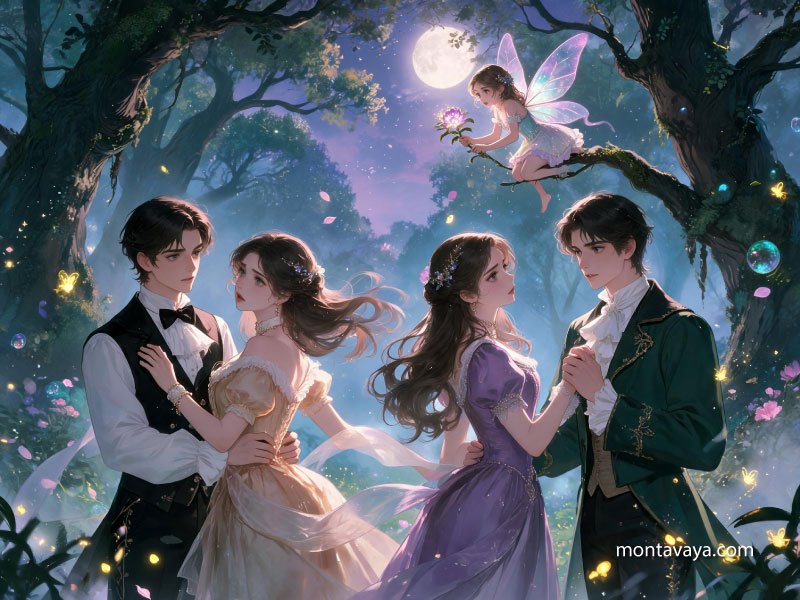
2026/06/02 A Midsummer Night’s Dream: A Forest Full of Beautiful Chaos!
Few works on an academic reading list have enjoyed the staying power of A Midsummer Night’s Dream. Written by William Shakespeare around 1595, the play appears regularly in high school literature courses, undergraduate English programs, theatre studies modules, and even introductory humanities classes. For a work involving fairies, love potions, and a man temporarily transformed with a donkey’s head, its academic influence is surprisingly serious.
One reason universities continue to teach the play is that it serves as an accessible gateway to Shakespeare. Students encountering Shakespeare for the first time often find his histories and tragedies intimidating, but A Midsummer Night’s Dream offers a more approachable entry point. The language is relatively accessible, the plot moves quickly, and the humour remains understandable even centuries later. Yet beneath the comedy lie themes that support sophisticated academic discussion. Scholars frequently use the play to explore questions of authority, free will, imagination, and the tension between social expectations and personal desires.
What makes the play particularly valuable in academic settings is how dramatically its interpretation has evolved. A student studying it in the 1950s would likely have encountered discussions centred on romance, harmony, and comic resolution. In today’s classrooms, however, conversations often focus on power and consent. For example, Oberon’s use of the love potion on Titania is no longer viewed purely as a humorous subplot. Many contemporary scholars examine it as an example of manipulation and control. This shift demonstrates one of literature’s most important lessons: texts remain relevant because readers continually find new questions to ask of them.
The play is equally popular in university theatre departments, though not merely because it is famous. Practical considerations play a significant role. Academic productions frequently operate under tight budgets, and A Midsummer Night’s Dream allows enormous flexibility. A production can feature elaborate woodland sets and special effects, or it can rely on simple lighting, minimal props, and imaginative staging. Both approaches can work equally well.
Its cast structure also makes it attractive to educational institutions. The play contains nobles, lovers, fairies, and the famously incompetent “mechanicals,” allowing a large number of students to participate. This is particularly useful for university productions that aim to give performance opportunities to entire cohorts rather than just a handful of lead actors.
Perhaps most importantly, student productions often become academic exercises in interpretation. One university might stage the fairy kingdom as a corporate boardroom to explore workplace power structures, while another might frame the story through contemporary discussions of identity and autonomy. In these cases, the performance itself becomes a form of literary analysis.
More than four centuries after its first performance, A Midsummer Night’s Dream remains firmly rooted on academic bookshelves because it rewards every generation with a different reading. And that raises a question students are still debating today: if each era finds a completely different meaning in the same text, are we studying Shakespeare’s ideas, or are we discovering our own?
Researched and Written by Shrirang Khare